
You can lose a lot of things in golf. Balls, bets, your temper, the plot on the back nine. You do not typically lose an entire golf course. But if the course only ever existed on paper, and the paper went into a drawer in 1930 and never came out, then yes, you can lose one. That is exactly what happened to El Boqueron, and the story of how it came back is the best thing happening in golf course architecture right now.
The Doctor Draws a Course He Never Builds
Alister MacKenzie was a Scottish-born surgeon turned golf architect, and by 1930 he was at the absolute top of his game. He had already built Cypress Point on the Monterey Peninsula and Royal Melbourne in Australia. He was about to team up with Bobby Jones on a little project in Georgia called Augusta National. When rich people wanted a golf course, the Doctor got the call.
One of those calls came from a wealthy family in Argentina who owned an estancia and wanted MacKenzie to build them something special. What he drew was one of the boldest ideas of his career. An 18 hole course with two returning nines and only nine greens. Nine enormous double greens, each one averaging around 30,000 square feet, richly contoured and defended in ways that let two holes share a putting surface without ever feeling like the same hole. For comparison, a typical green is 5,000 to 6,000 square feet. MacKenzie was drawing greens the size of a hockey rink.
Then the Depression hit. Argentina's economy went sideways, the family's money did too, and El Boqueron never broke ground. MacKenzie died in 1934. His drawings for the course disappeared, and for most of a century the golf world assumed they were gone for good, filed under great ideas that never happened.
The Drawings Turn Up
They were not gone. The El Boqueron plans resurfaced, and they landed in front of a man named Wes Farrell. Farrell is an attorney who built a very large law firm, and he happens to be the son of the songwriter Wes Farrell, the man who co-wrote Hang On Sloopy and produced the music for The Partridge Family. The younger Farrell had a different dream, which was to build a golf club from scratch in the Sandhills of South Carolina, east of Aiken and a short drive from Augusta. He called it 21 Club, and for his first course he decided to give the Doctor his lost design.
To pull it off, Farrell assembled what the club calls the MacKenzie Architectural Committee, a group of MacKenzie scholars and course modeling specialists led by architect Brian Zager. If that name rings a bell, it should. Zager worked with Tom Doak on The Lido at Sand Valley in Wisconsin, the project that resurrected C.B. Macdonald's lost Long Island masterpiece using old photographs and computer modeling. He is the guy you call when the course you want to build no longer exists.
Ground broke in January 2025. By the week of the 2026 Masters, the course was hosting preview play for members and guests. Ninety six years after MacKenzie drew it, El Boqueron finally had grass on it.
Not a Copy. An Interpretation.
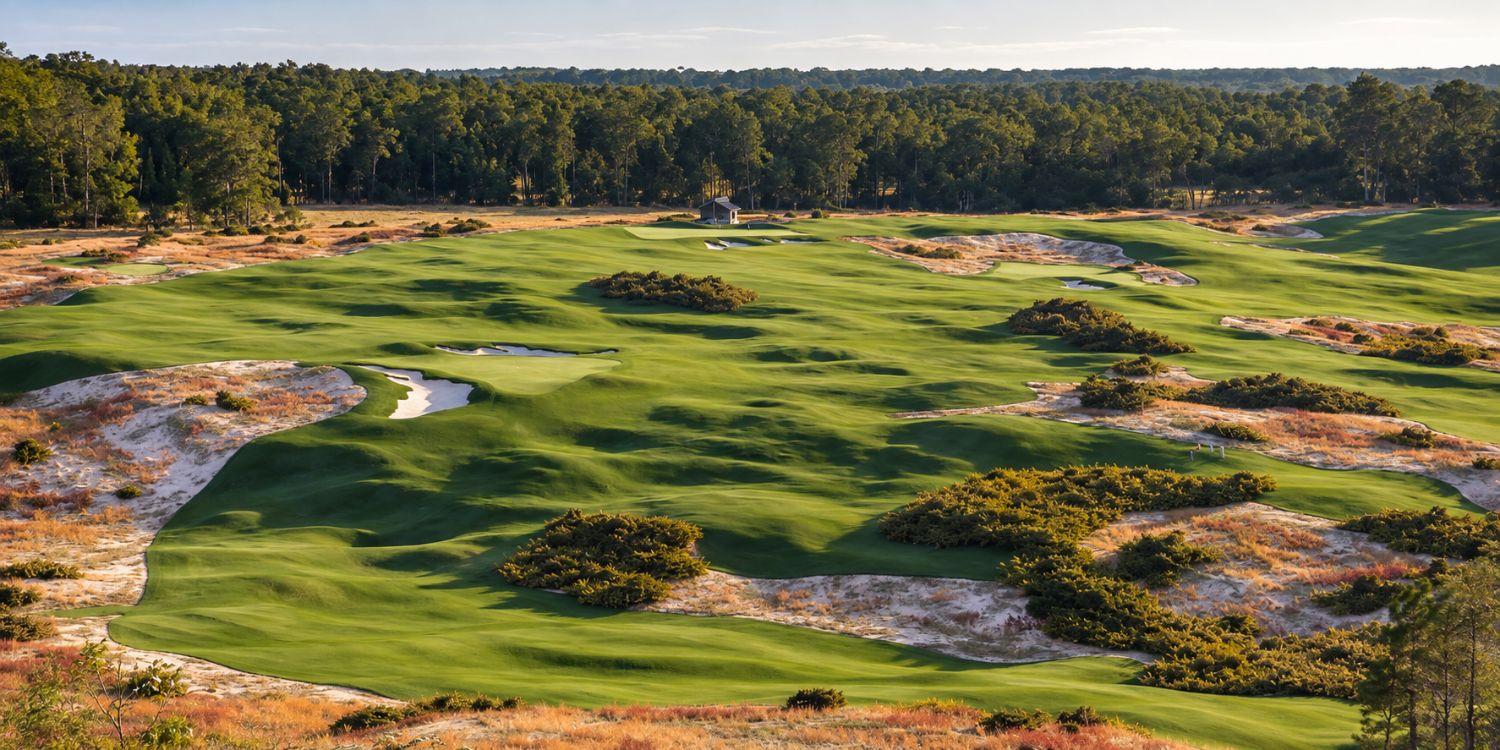
Here is where it gets interesting for golf nerds. The Lido was built as a faithful recreation, an attempt to put the exact course back on earth. The MacKenzie Course at 21 Club is not that. It is an interpretation. The routing follows El Boqueron, the nine double greens are there, and the spirit of MacKenzie's plan is intact. But the course has been adapted to the sandy, rolling ground of the Carolina Sandhills rather than the Argentine pampas, and it has been stretched.
That stretching is the clever part. The course can be played at its original Golden Age yardage, the length MacKenzie designed it for when a good drive went 220 yards. Or it can be played from an expanded championship footprint built for the modern game. Or a hybrid of the two. You can play the course the Doctor drew in the morning and the course a tour pro would need in the afternoon, on the same greens.
And those greens are the whole point. With nine shared putting surfaces and an interconnected routing, you can see multiple greens from almost anywhere on the property. Groups cross paths, wave, heckle, and watch each other's approach shots. MacKenzie believed golf should be social and a little bit theatrical, and a double green the size of a parking lot with two flags on it is about as theatrical as golf gets.
What Else Is Coming
The MacKenzie Course is the first of two 18s at 21 Club. The second is called The Hammer, and it is being built by Rob Collins, Tad King, and Trevor Dormer, the crew behind Sweetens Cove and Landmand. The Hammer is designed specifically for match play, which means wild risk reward holes, no obsession with par, and a course that wants you to have a bet on the first tee. A family short course, a performance center, and member owned cabins are in the plan as well.
If you have been paying attention, you know this is part of something bigger. The stretch of Sandhills from Aiken across the Georgia line has quietly become the hottest private golf development in the country. The Tree Farm, Old Barnwell, Broomsedge, Fall Line. Add 21 Club and you have a corridor of new golf that did not exist five years ago, all within an hour of Augusta National.
Can You Play It?
Here is the honest part. 21 Club is a high end private club, and the MacKenzie Course is for members and their guests. There is no tee time to book and no stay and play package. If you want to see El Boqueron in person, your path runs through a member, and if you know one, this is the moment to remember his birthday.
That said, Aiken itself is worth the trip. It is a horse town with a walkable downtown, good restaurants, and a golf history that predates most of America's famous clubs. Aiken Golf Club, a public course built in 1912, is one of the coolest old school rounds in the South and costs less than a nice dinner. Pair it with a Masters week visit, or a fall trip when the Sandhills are at their best, and you can at least drive past the gates and know what is happening behind them.
Alister MacKenzie drew a course in 1930 that nobody got to play. Somebody finally built it. That alone is worth knowing about, even if the closest you get is the story.
Website: 21 Golf Club